Deterministic Measurement Framework
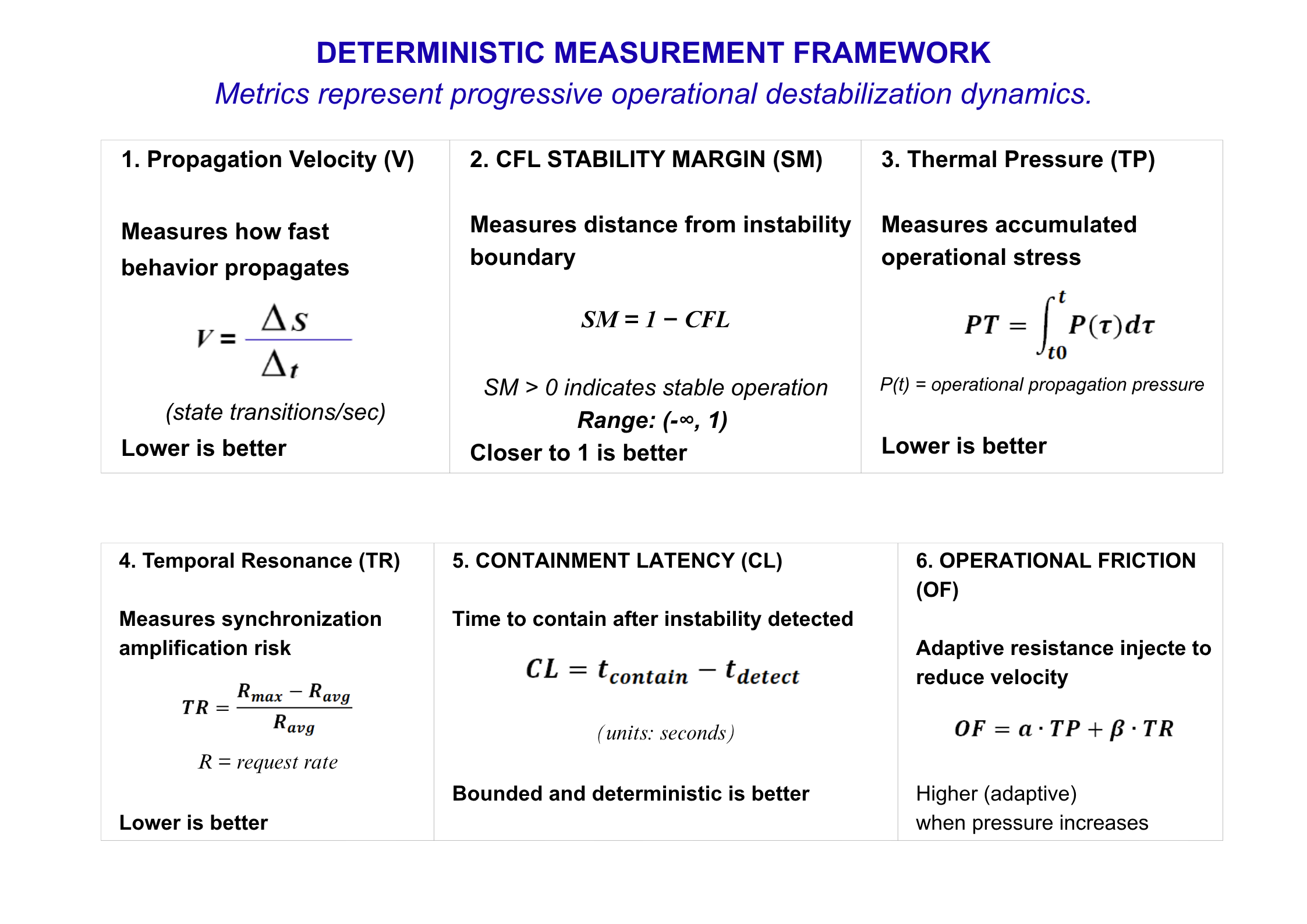
Cyber-Physics establishes a deterministic governance layer designed to preserve operational stability, governance continuity, and evidence integrity across distributed cyber infrastructures.
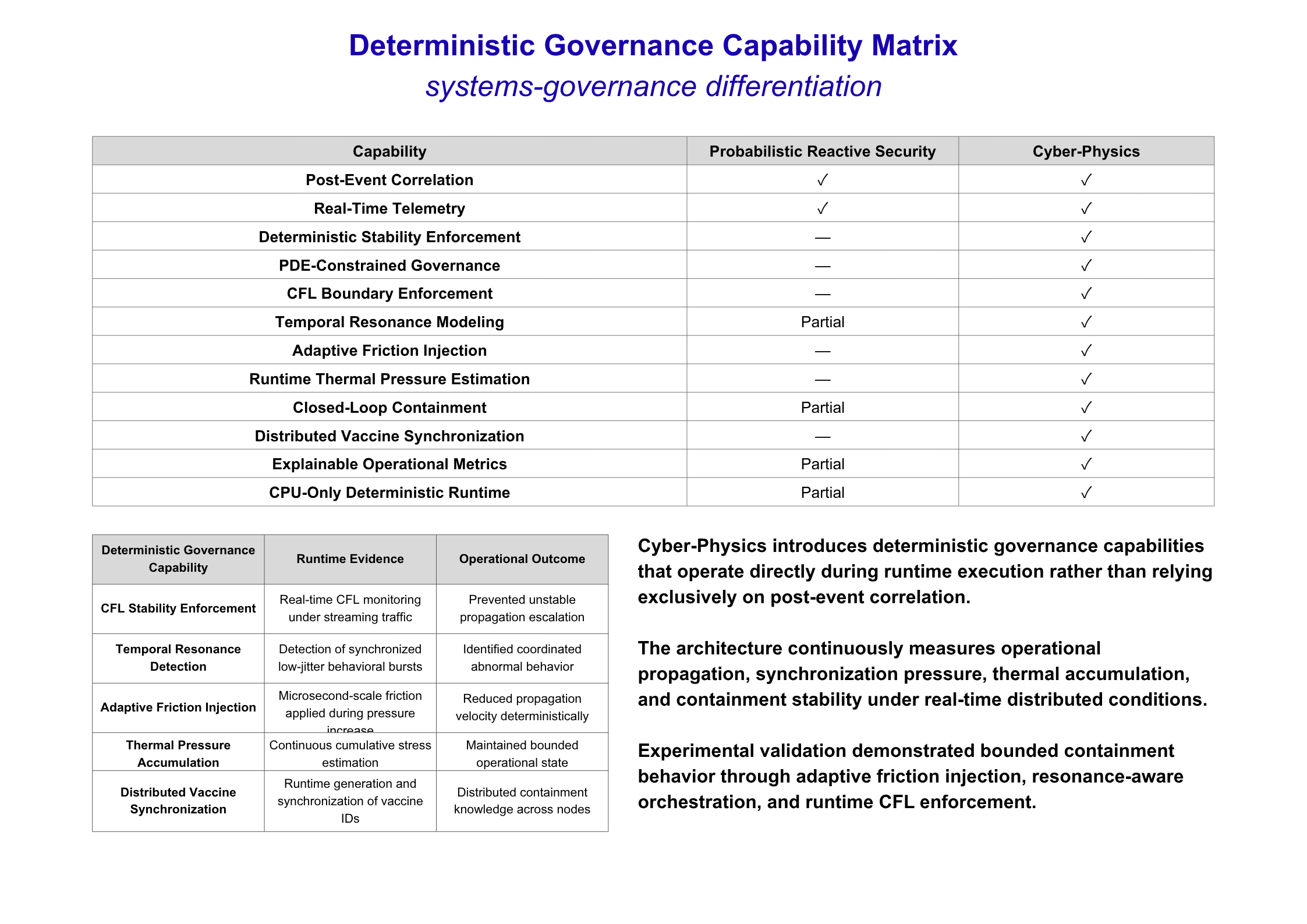
Cyber-Physics is a deterministic operational governance framework designed to operate alongside existing cybersecurity ecosystems.
Rather than replacing SIEM, XDR, EDR, NDR, or observability platforms, Cyber-Physics provides an additional governance layer focused on operational continuity and runtime stabilization.
Modern cyber infrastructures generate vast amounts of telemetry and alerts.
While visibility and detection capabilities continue to improve, operational complexity continues to grow.
Cyber-Physics focuses on preserving predictable operational behavior through deterministic governance mechanisms rather than relying solely on post-event analysis.
Continuous observation of runtime conditions and operational signals.
Identification of governance-relevant operational deviations.
Execution of deterministic governance actions and stabilization policies.
Achievement of operational continuity and governance equilibrium.
DGEC serves as the evidence and traceability layer of Cyber-Physics.
Every governance transition is recorded in a deterministic evidence chain designed to preserve accountability, continuity, and validation integrity.
Replay Architecture enables deterministic reconstruction of governance events.
This capability supports runtime validation, governance review, operational analysis, and evidence verification.
Portable enterprise runtime architecture.
Designed for cloud-native deployment models.
Simplified deployment and lifecycle management.
Independent execution model preserving operational boundaries.
Cyber-Physics is built upon the principle that operational truth should be preserved through deterministic governance mechanisms rather than inferred solely from historical observations.